Edibility of Outer Wilds' Main Races
by craniumknight, flipsonthemoon, LVS12345, and mushrium
A very brief exploration of the edibility of the 3 main races of Outer Wilds (Dungeon Meshi style).Using both in-game and real life evidence, we hypothesized the tastes, textures, and potential uses of different parts of the aliens. We then made a couple of dishes and drew what they would look like.Additionally, we looked a little bit into the science of creating meat substitutes through mass spectroscopy
and gas chromatography.
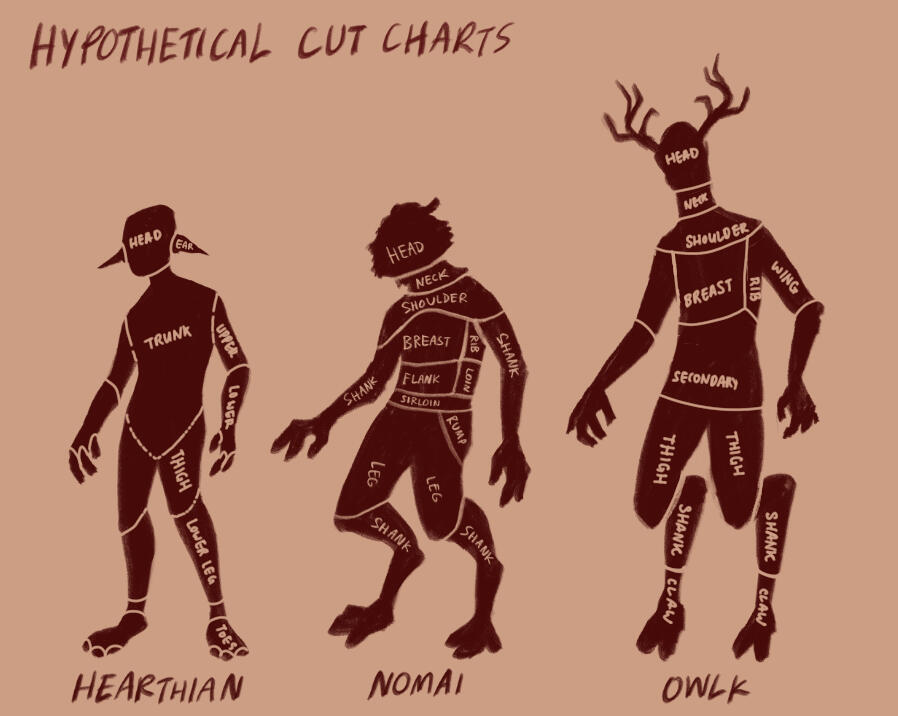
Hearthians
researched by flipsonthemoon
Hearthians are similar to frogs in that they are like an aquatic chicken with a light/delicate flavor.Hearthians are prized for their large and collagen-rich ears.Most of the Hearthian is lean and a little bit bland with a fishy aftertaste due to their fish and amphibian-based diet.Their large middle(?) finger has a meat-skin-bone ratio similar to chicken wings.
Hypothetical dishes:
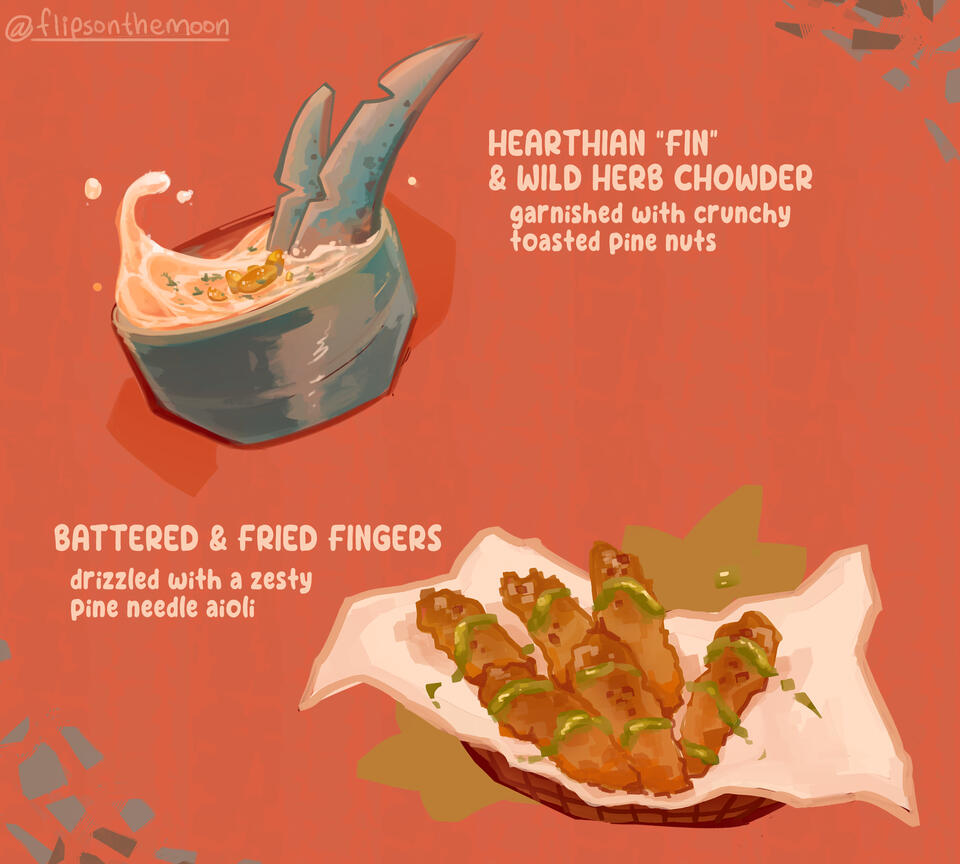
Main: Battered & fried fingers topped with peppery centipede flakes. Served with a zesty pine needle dipping sauce.Side: Hearthian “fin” & wild herb chowder, garnished with crunchy pine nuts. Served with campfire bread.
Nomai
researched by craniumknight
Nomai are goat-like, but being bipedal their legs are the most substantial part of their body in terms of amount of meat.Because of that, most of their meat is very tough and fibrous. It would need to be stewed or slow cooked for a long time for the collagen to break down, making it more tender and palatable.The flavor is similar to goat/lamb but a little milder. It has a sharp flavor, is slightly gamey, and is very earthy. It also has a very distinctly sharp smell, likely due to their assumed wild plant-based diet.
Hypothetical dish:
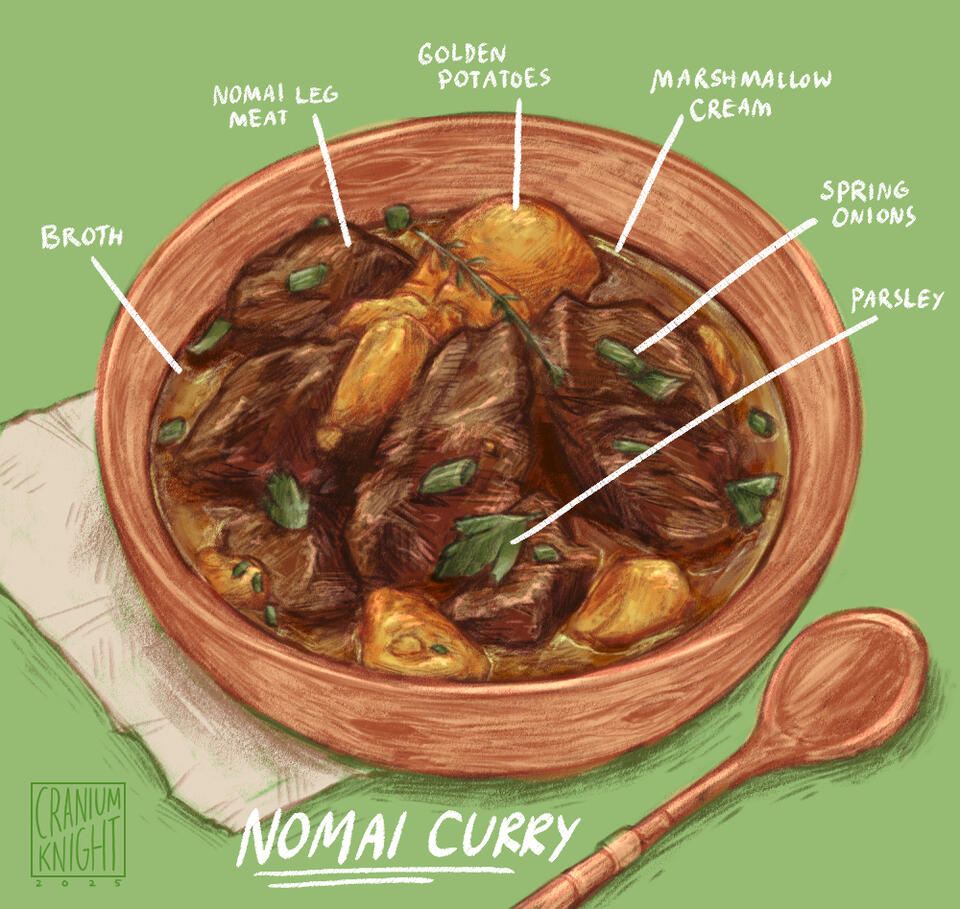
Main: Spicy Nomai curry. Stewed in a fragrant fish broth containing wild berries, onion, habanero, garlic, and ginger found on Timber Hearth. Served in a bowl over a warm bed of wild rice.
Owlks
researched by mushrium
Owlks are of the warm-blooded theropods' family, similar to those of a chicken, duck or owl. While they contain features of other species, such as their antlers and scales, this does little to affect the primary edible parts of their flesh–which would constitute the breast, thighs and wings.Similarly, owlks lay hard-shelled eggs, with unfertilized eggs serving as a protein source for owls as well as other beings. Due to the abundance of eggs compared to population size, these are most favoured as meals. The flavour is similar to a quail or chicken egg. However, the large mass (similar to that of an ostrich) means that one egg can serve multiple meals.It’s theorized that the meat would be sinewy due to the comparative lack of flesh compared to the relative size of owlks.The artificial habit of the Stranger is similar to that of a swamp, where plants such as cat-tail and mint would be able to grow. The watery biome would grow plants such as reeds and kelp, which could be used to make an edible spread.
Hypothetical dish:
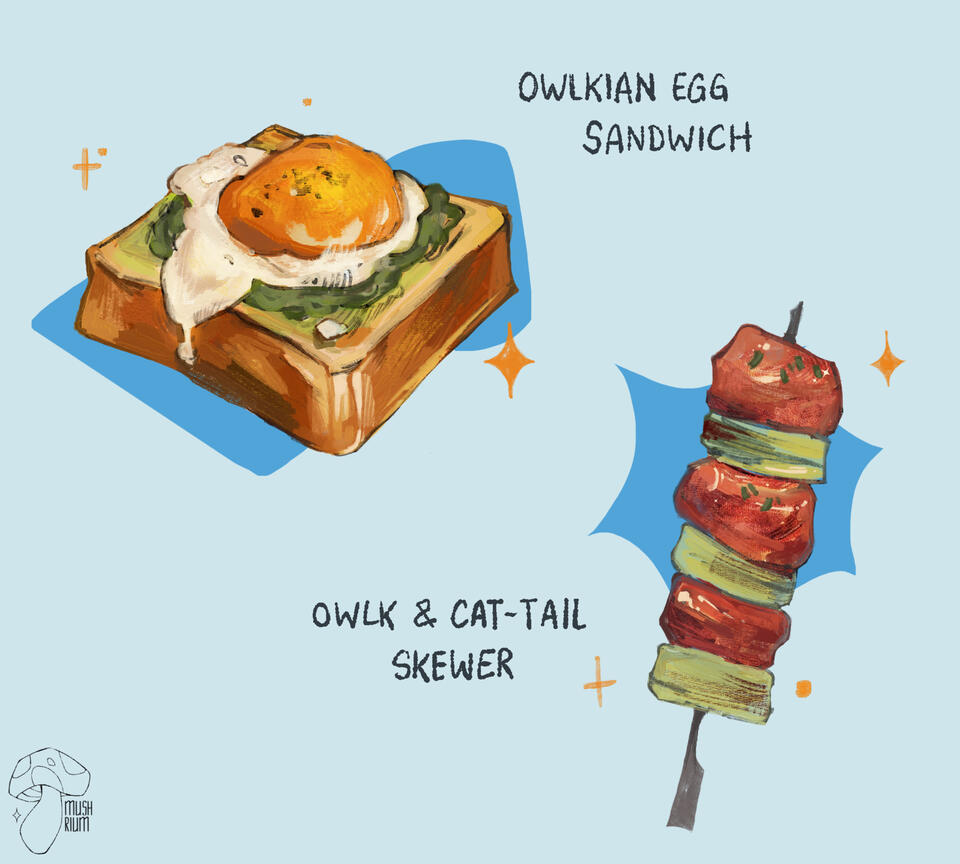
Main: Fire roasted sunny-side up owlk egg. Served on a grass-wheat brioche bread, with a kelp and herb ground paste.Side: Owlk “nugget” & battered swamp cat-tails, garnished with crushed mint.
Fake Meat
researched by LVS12345
Intro
So recently I had heard that there was a little more science to fake meats than I had originally thought. I had heard that there was some chemical analysis used to match the flavor profile of fake meat to real meat. Intrigued, I decided to do a bit more research into the topic.
Gas Chromatography - Mass Spectroscopy
The first thing I found was this article about the impossible burger. I believe that this article is likely to be the one that I had heard about second hand. It covers a lot of aspects of what goes into making impossible meat, but what was most important to me was that it named the chemical analysis technique used: gas chromatography - mass spectroscopy. Apparently, if something has the same volatile compounds/aromas as something else it will taste the same. And these compounds/aromas can be analyzed using gas chromatography - mass spectroscopy. Now I had something to look into. Naturally, the next place I went was Youtube.The first thing that I learned about gas chromatography - mass spectroscopy is that it’s actually 2 different things: gas chromatography and mass spectroscopy (wow!). Some videos covered one or the other, some covered both. It seems that these 2 analysis methods are often used together but can be used and explained independently of each other.Gas Chromatography
Gas chromatography is used to separate different compounds in a mixture by retention time, or the time it takes the compound to pass through a system. A liquid or gas sample is injected into a machine consisting of a heater, a long tube, and a detector at the end. Different compounds take different amounts of time to pass through the tube, and as a result come out the other end at different times. This is the essence of how gas chromatography works, but next I’ll get into slightly more detail.The heater vaporizes the sample which is then pushed through the tube (called the column) by an inert gas (called the mobile phase). The gas is inert so that it doesn’t react with the compounds being analyzed. While in the column, the different compounds in the mixture separate based on various characteristics like boiling point, volatility, etc.. The inside of the column is coated with something called the stationary phase that may help separating compounds based on polarity as well. Polar compounds will feel polar attraction towards the stationary phase and as a result move slower through the column. The column is often very long and coiled up inside the instrument to give the compounds time to fully separate. On the other side of the column the detector senses compounds leaving the system which can then be displayed as a chromatogram, a graph that shows the amount of a compound leaving the system versus time. If you know what compounds are in your mixture and you just need to know how much of each is in your mixture, this might be enough data for you. If you need to figure out what compounds are in your mixture, this is where mass spectroscopy might come in handy.Mass spectroscopy
Once the compounds are separated out by gas chromatography, mass spectroscopy can help determine what those compounds are. The general idea here is that a compound is ionized and then the mass to charge ratio can be determined. These 2 steps can be carried out in a variety of ways. For example, a compound can be ionized by bombarding it with electrons (a process known as electron ionization). Then to determine the mass to charge ratio it might be accelerated in a constant voltage field, imparting a known amount of kinetic energy onto the molecule, and the time it takes to reach a detector some known distance away can be used to determine the mass, since kinetic energy is proportional to mass and velocity (a process known as time-of-flight spectroscopy).The mass to charge ratio of the compound alone isn’t enough to determine the composition and structure of the compound but mass spectroscopy does provide more data than just that. The compound can also break into ionized fragments during the ionization process. The mass to charge ratio of these fragments is also recorded. The frequency with which a molecule with a particular mass to charge ratio is detected is recorded on a mass spectra. This information about the mass of the compound and the fragments it breaks into can be used to help determine the composition and structure of the compound.Even with all of this information, determining the original compound can still be difficult. Atoms that make up the compound can have isotopes with varying weights that need to be taken into account. Patterns that appear in the mass spectra can have multiple explanations. To make a determination by hand requires some amount of guessing and checking, taking in the information available from the gas chromatogram and the mass spectra and trying to propose a compound that would produce the same results. Today, massive databases of previous results are used in tandem with computers to assist with the identification of complex compounds and their structures.
Conclusion
Something that I thought was interesting about Impossible Meats application of this is that they don’t really need to know what exact compounds are in the meat. As long as the compounds they put into their fake meat result in similar chromatograms and mass spectra it should taste similar. And they were pretty much right if you ask me. I mean have you had an impossible burger? I don’t think I could tell the difference between that and a real burger.Now let’s say, hypothetically, you wanted to know what Hearthian or Nomai or Owlk meat tasted like. Lets say you wanted to make an ethical Hearthian burger. All you would have to do is sacrifice one Hearthian to make a real meat burger, collect the aromas, send them through a long tube, ionize them, and take some measurements, and reverse engineer some compounds that imitated real Heartian meat. Or you could just look at this nice art we have of food made from each of the Outer Wilds races and let your imagination do the rest. Enjoy!
Sources
This is the article that I also mentioned in the intro section. It’s nice if you want a broad overview of the state of impossible meats that extends beyond the chemical analysis techniques they use.I watched a lot of videos on this stuff so this is by no means a comprehensive list of all the videos I’m drawing from. Most of them are pretty easy to find just by searching “gas chromatography mass spectroscopy” on youtube so I didn’t include a lot of them. Below are just the ones that I found most helpful personally.Gas chromatography videos:
https://www.youtube.com/watch?v=F9NUXkyIl5AMass spectroscopy videos:
https://www.youtube.com/watch?v=HmocyWfMHTQ
https://www.youtube.com/watch?v=6O_85tKfZHcThis last source I found very helpful after watching a bunch of videos. Jeol is a manufacturer of scientific instruments/equipment. This page they have is full of diagrams/figures that helped clarify the information that I had gathered from other sources. They also cover some different methods of ionization and analysis so if you're interested in going into a bit more detail I think this one is worth checking out.
https://www.jeol.com/products/science/gcms.php